

Semrush’s YMYL Data vs What We’re Seeing in Australia
AI search doesn’t treat every industry the same, and if you’re a doctor, lawyer or financial adviser, it’s playing by stricter rules.
Ask ChatGPT for the best running shoes and it’ll happily quote reviewers and Reddit threads. Ask it about a fertility treatment or a family law matter, and the tone changes. Suddenly it’s leaning on government pages, professional bodies and big, established names.
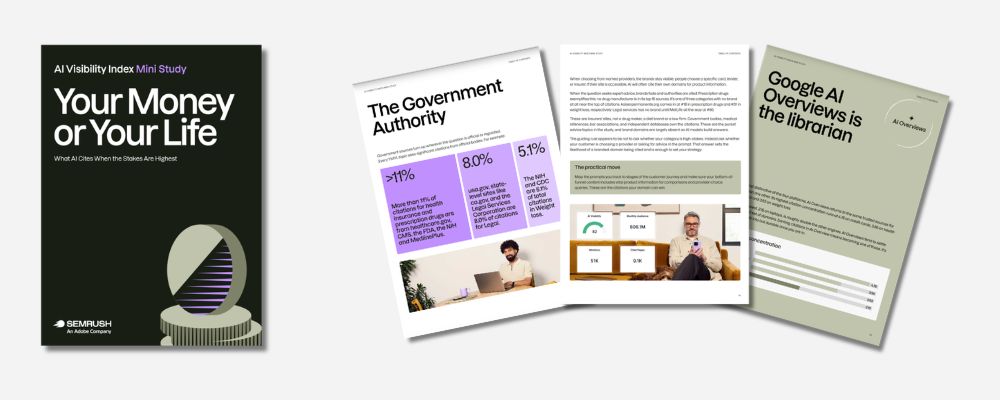
That’s not just a hunch. Semrush recently published a study called Your Money or Your Life: What AI Cites When the Stakes Are Highest. It analysed which sources ChatGPT, Google AI Overviews, Gemini and AI Mode cite across 22 consumer topics, including legal services, prescription drugs and health insurance.
The catch? The data is from the US, with a UK cross-check. There’s no Australian data in it.
So we did what we always do: checked it against what we’re actually seeing with our own clients. That includes a Brisbane fertility specialist we’ve been working with since May, and a handful of conversations and live tests in the Queensland legal space.
Here’s what the research found, where our experience lines up, and what it means if you run a practice in a Your Money or Your Life (YMYL) industry in Australia.
New to YMYL? Start with our guide to what YMYL industries are and how Google treats them.
What the Semrush Research Found
Semrush compared 11 YMYL topics (credit cards, insurance, mortgages, prescription drugs, weight loss, legal services and more) with 11 everyday shopping topics like laptops, mattresses and coffee makers. Five patterns stood out.
1. Government sources show up wherever there’s an official answer
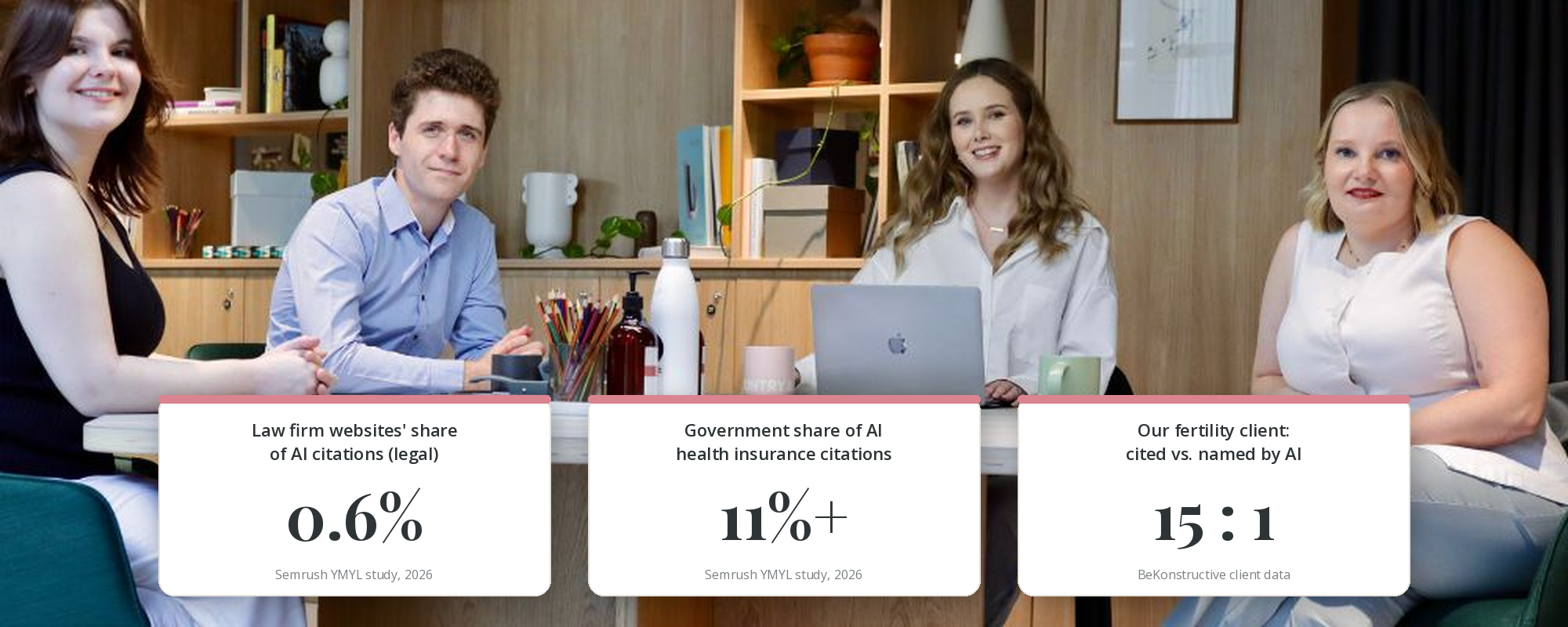
Every YMYL topic saw a big lift in citations from official bodies. More than 11% of citations for health insurance and prescription drug questions came from sites like healthcare.gov, the FDA and the NIH. Government and legal aid bodies made up 8% of citations for legal services.
For everyday products, government sources barely register: 9 of 11 topics sat at 0.2% or less.
2. Reddit takes a back seat when the stakes go up
Community sites like Reddit and YouTube make up about one in seven citations for everyday products. In most YMYL topics, that drops to 6 to 9%. People happily debate earbuds on Reddit. They’re less likely to crowdsource their prescription.
3. AI leans on a small circle of trusted sources
In tightly defined YMYL topics like credit cards and mortgages, AI returns to the same handful of pages again and again. Legal services is the exception. Its citations are spread across thousands of law firms, directories and forums, because “legal” covers everything from conveyancing to criminal defence.
4. Whether your brand gets cited depends on the question being asked
This is the big one. When someone is choosing a provider (a credit card, a lender, an insurer), brands get cited. Credit card brands earned 20.6% of citations.
When someone is asking for advice, brands almost disappear. Brand-owned websites earned just 0.6% of citations for legal services, 0.9% for weight loss and 1.3% for prescription drugs. Those citations went to government bodies, medical references, bar associations, and independent databases instead.
5. Each AI platform behaves differently
Google’s AI Overviews is the “librarian”: it sticks to a small, trusted set of sources. Hard to break into, but durable once you’re in. ChatGPT is the “reporter”: it casts a much wider net across media and review sites, so it’s easier to get into but cites you less often.
Semrush’s advice for advice-led industries like medical and legal is to become “the source behind the sources”: the study a health site quotes, or the practitioner a legal directory references.
Source: Semrush, Your Money or Your Life AI Visibility Index Mini Study, US data captured June 2026, weighted towards Google AI Overviews.
What We’re Seeing: A Brisbane Fertility Specialist
As a Brisbane SEO agency, we are working with a broad range of service-based businesses both in YMYL industries as well as outside of them. One of our current clients is a Brisbane-based fertility specialist. We can’t name them, but their situation is a near-perfect test of the Semrush research.
The starting point
Their website moved to a new domain in late 2025, a few months before we came on board. As with any new domain, the site was building its search visibility from a fresh start, and in a medical niche that trust takes time to earn.
We came on board in May 2026. Since then, the work has focused on the foundations:
- Rewriting the key service pages, starting with the homepage and then moving onto the service-specific pages
- Building out their credentials and E-E-A-T signals on the page
- Internal linking
- Setting up proper conversion tracking in GA4
- Optimising their Google Business Profile
- Citation and directory work, which kicks off this month
Clinics win, individual doctors struggle
When we search “IVF doctor Brisbane” on Google, page one is almost entirely the big fertility clinic groups. Only two individual doctors make the cut. There’s also a Reddit discussions block, which the Semrush data says should be rarer in health topics.
ChatGPT is the same story. Ask it for fertility doctors in Brisbane and you get a list of clinic groups and their locations, not individual specialists.
That lines up with Semrush’s “trusted few” finding: AI (and Google) lean on the established names. For a specialist in private practice, that’s the wall you’re up against.
Cited, but not named
This was the most interesting part of the data. In its latest snapshot, Semrush’s AI Visibility tool recorded our client’s website being cited as a source 15 times across AI answers. It recorded them being mentioned by name just once.
In practice, that means AI is using their content to answer questions like “what is IVF” or “how much does egg freezing cost in Brisbane”, but it isn’t telling people who wrote it. They become a “source behind the sources” without getting the credit.
Every one of those citations came from Google’s AI Overviews. That fits Semrush’s “librarian” description: AI Overviews rewards solid, well-structured pages on a site that already ranks.
ChatGPT is sending real visitors
Semrush’s AI tracking showed no ChatGPT visibility for them in recent weeks. But Google Analytics tells a different story. Since May, ChatGPT has sent 46 visits to their website. That’s about 0.4% of the total traffic, and those visits led to three conversions.
Where they landed is telling:
| Landing page | Visits from ChatGPT | Conversions |
|---|---|---|
| Homepage | 15 | 2 |
| An old blog post from his previous website, which no longer exists | 14 | 0 |
| IVF service page | 3 | 1 |
That second row is the one that surprised us. ChatGPT is still sending people to an informational blog post from the old website, published back in 2019. That page isn’t part of the new site, so those visitors land on a “page not found” error. Nearly as many AI visits went there as to the homepage, and none of them converted.
It’s a good reminder that AI tools can hang on to old URLs long after a website changes, so it pays to keep an eye on where they’re sending people. It’s also the “intent split” from the study: the visits that turned into enquiries came through the homepage and service pages, not informational content.
It’s also a reminder that AI tracking tools only test a sample of prompts. Your own analytics may show AI traffic the tools miss, so check both.
The name problem
Here’s something the Semrush study didn’t cover. Our client shares their name with doctors in other specialties and other countries, and AI regularly mixes them up. Some of the AI “mentions” were really answers about an orthopaedic practice and an overseas medical centre with similar names.
If AI can’t tell which doctor you are, it can’t recommend you. Consistent, verifiable credentials across your website, AHPRA listing, Google Business Profile and directory profiles matter even more here.
What We’re Seeing: Queensland Law Firms
The Semrush headline for legal services is stark: law firms’ own websites earned just 0.6% of AI citations. So we went looking.
Search for a lawyer, and you’ll find law firms
We ran a few live searches for Brisbane lawyers:
- ChatGPT (“Brisbane lawyer”): a list of local firms, neatly grouped by practice area (family, criminal, property, employment and commercial). At the bottom, it pointed people to the Queensland Law Society’s solicitor register to check that a lawyer is currently practising.
- Google (“Brisbane family lawyer”): traditional results only, with no AI Overview. Page one was all family law firms, plus a Reddit discussion block.
- Google AI Mode (“Brisbane family lawyer”): a list of Brisbane family law firms, and no government sites in sight.
At first glance, that looks like it contradicts the research. It doesn’t. These are all “choosing a provider” searches, and the study found brands stay visible when someone is picking who to hire. The 0.6% figure covers legal questions as a whole, which includes plenty of advice questions like “what are my rights if…”. Firms are cited when you’re shopping for one, and fade when you’re asking for legal information.
The Law Society still made an appearance, though: as the place ChatGPT sends people to verify a lawyer. That’s the authority layer doing its job.
Directories and memberships open the door
This part is anecdotal, but it came up at an industry event recently. We were chatting with other SEOs about the legal industry, and the consensus at the table was clear: it’s very hard to get a Brisbane or Queensland law firm’s website properly indexed without listings on Doyle’s Guide and the Queensland Law Society.
That matches what we’ve seen firsthand in traditional SEO. Without those authoritative associations backing up a firm’s credibility, even a technically sound website with good content can fail to get indexed. We’ve seen that play out with a real client.
One freelance SEO at the table works with several Queensland law firms and is researching the same question for AI search. Her early findings echo ours: if those memberships and credentials aren’t publicly visible, you’re unlikely to show up in AI answers either.
That’s industry conversation, not a study, so take it with a grain of salt. But it lines up neatly with Semrush’s advice to “earn a place on the shelf AI already trusts”.
Learn more about our SEO services for law firms here.
The Flip: Why YMYL Content Works Backwards
This is the pattern we’ve noticed most across our YMYL clients, and it’s the opposite of almost every other industry we work with.
For most businesses, informational content is the easy win. An electrician’s guide to choosing the right size air conditioner for your home will rank without much fuss. Getting that same electrician to rank for “electrician Brisbane” is the real battle.
For our medical and legal clients, it’s the other way around. Their commercial pages (the ones that describe their services) are relatively easy to get indexed and ranking. Their long-tail research and information content is much harder, in both traditional Google and AI search.
Our fertility specialist records a podcast, and each episode has it’s own landing page with overviews of the content. Those pages have been noticeably harder to get indexed than the service pages. And as their analytics showed, the informational content AI does send traffic to isn’t the content that converts.
That’s exactly what the Semrush data would predict. In advice-led topics, AI and Google hand the authority to government bodies, medical references and professional associations. A private practice’s service pages still have a job to do when someone is choosing a provider. Its general health or legal advice is competing with sources Google trusts far more.
What This Means for Your Practice
If you’re a doctor, lawyer, accountant or financial adviser, here’s where we’d put your energy.
- Make your service pages do the heavy lifting. When someone is choosing a provider, your own website can be cited. Make sure your service pages clearly explain what you do, who it’s for, what’s involved and what it costs (within your AHPRA, ACCC or ASIC obligations).
- Get on the shelf AI already trusts. For lawyers, that means the Queensland Law Society and Doyle’s Guide. For health practitioners, that means your AHPRA registration, your college and association memberships, and the directories patients actually use. These aren’t nice-to-haves in YMYL.
- Make it obvious who you are. Use your full name, credentials and registration details consistently everywhere: your website, Google Business Profile, directory listings and social profiles. This matters even more if you share a name with someone else in healthcare or law.
- Be realistic about advice content. Informational articles and podcasts still build trust with real people. But don’t expect them to outrank government health sites or legal aid bodies. Write them for your patients or clients first, and link them back to the services they relate to.
- Check your analytics, not just the AI tracking tools. GA4 now has an “AI Assistant” channel. Look at which pages AI is sending people to, and whether those visitors actually enquire.
The Bottom Line
Semrush’s research is US-based, but so far the patterns hold up in Australia. In YMYL industries, AI trusts authority over brands, and it rewards you most when someone is choosing a provider rather than looking for advice.
The good news? The things that earn AI visibility in these industries are the same things that build real-world credibility. That means verified credentials, the right memberships, well-built service pages, and a consistent presence across the places people (and AI) go to check you out.
There’s no shortcut here, and in regulated industries, shortcuts can do real harm. But it’s absolutely doable with the right approach.
If you run a practice in a YMYL industry and want to know how you’re showing up in AI search, we’d love to have a chat.
Book a free SEO discovery call →
Or if you’d like to see what’s involved and what it costs, take a look at our SEO packages and pricing →