


In this law firm SEO case study, a Brisbane property law firm went from two disconnected websites to nearly 8x organic traffic in six months, once we consolidated 280+ articles onto one domain and fixed the content structure underneath it.
We work with a lot of businesses who think their SEO problem is “we need more content”. Every now and then we get one where the real problem is: you’ve got two entire websites, and they’ve never been introduced to each other.
This is one of those.
The short version: a Brisbane property law firm came to us with a genuinely excellent content engine – podcasts, YouTube, blogs, the whole machine – and almost none of the SEO value from it was reaching the website that actually generates business. Over six months, we fixed that. Organic search sessions went from 1,922 to 15,038 per month. That’s not a typo. That’s the same business, doing the same good work, just no longer sabotaging itself.
Here’s what actually happened.
The Set-Up: A Great Marketing Machine, Split in Two
Before we came on board, our client had a genuinely impressive content operation running. They were recording podcasts regularly, filming them for YouTube, cutting them into social snippets, and turning the transcripts into blog articles. That’s more consistency than most SEO agencies manage to get out of clients who are paying them specifically for content.
The problem wasn’t the content, it was the plumbing.
All of that high-quality, long-tail-SEO-friendly educational content was sitting on a separate HubSpot blog, hosted on its own subdomain – completely disconnected from his primary commercial website. So every bit of domain authority, every ranking signal, every scrap of SEO equity that content should have been building for his actual business pages was accumulating somewhere else.
On top of that, the content itself had a few structural issues that are easy to fall into when you’re creating regularly and going on instinct:
- No keyword strategy – topics were chosen on gut feel and industry relevance (a genuinely solid starting point), but with no research behind it, a lot of search opportunity was being left on the table.
- Content cannibalisation – every time there was a legal update (say, a change relevant to conveyancing), a brand new article got created rather than the old one being updated. Over time, this meant multiple articles competing with each other for the same topic instead of one strong, authoritative page.
- No on-page optimisation – the process was largely “transcript in, intro and outro added, publish”. No subheadings built around search intent, no internal linking, no real SEO structure.
None of this makes him unusual, by the way. This is what happens when you’re good at creating content and busy running a law firm – SEO structure is the bit that gets skipped, because it’s invisible until it isn’t.
What We Actually Did (Over 6 Months, About 100 Hours)
He signed on initially for a 3-month engagement at 10 hours a month. He extended it to six months at up to 20 hours a month once he saw what was moving – which is generally a good sign that the work is landing.
Month 1-2: Foundations and benchmarking
Before touching anything, we needed accurate data. That meant auditing his Google Analytics and Search Console access, replacing outdated tracking, and setting a real baseline. We also ran a technical health check and found a backlink profile of roughly 133,000 links, with 30-40% flagged as toxic – the kind of thing that sits quietly in the background undermining everything else you do.
The big one: migrating 280+ articles onto one domain
This was the single highest-leverage piece of work in the entire engagement. We migrated the entire HubSpot blog – every article, every image, every internal link – across to WordPress, hosted properly under his primary domain. That meant full redirect mapping from the old site to the new one, re-checking every link, and making sure nothing broke in transit.
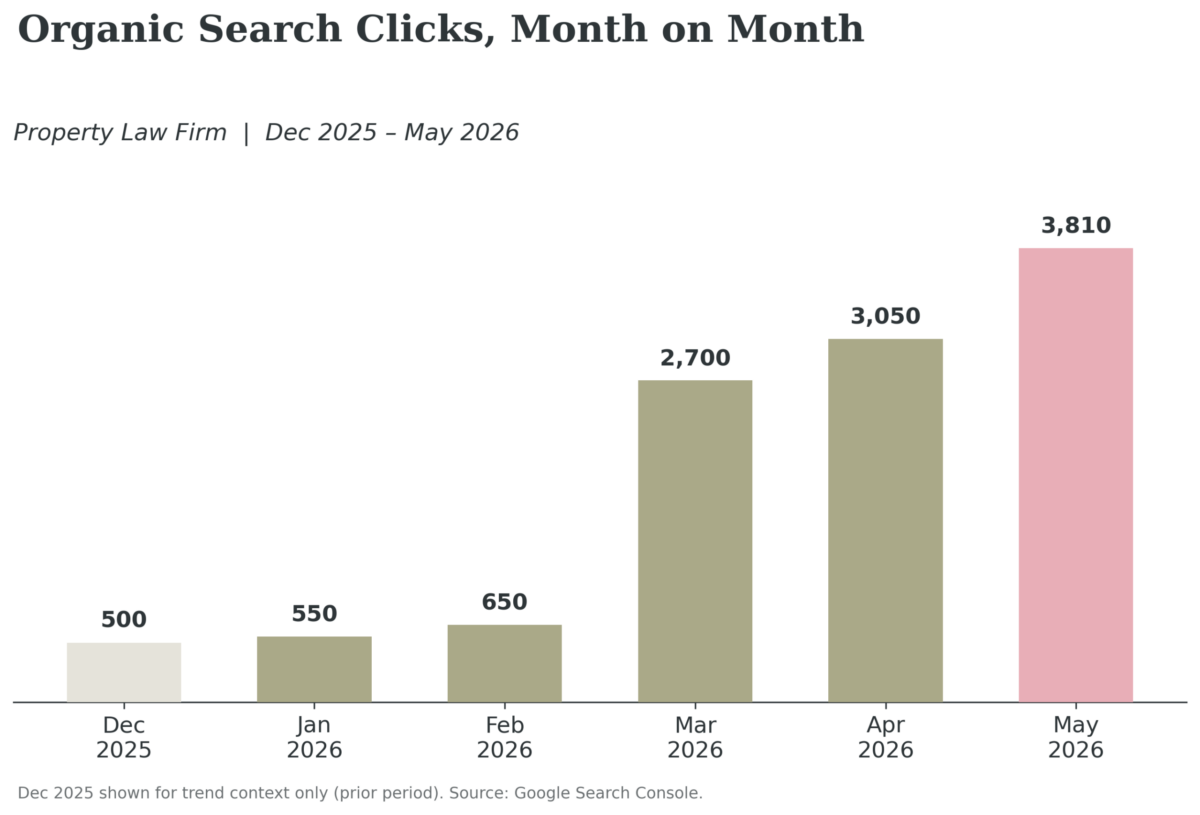
The impact was immediate and visible in the data – you can see almost exactly which month this went live, because the graph inflects. Suddenly all that great content was feeding SEO equity into the same domain as his conversion pages, instead of two disconnected domains doing their own thing.
Then: content structure and quality
With everything under one roof, we turned to on-page issues – thin “news and media” pages that were essentially empty stubs linking out to press features, and a set of roughly 20 suburb/location pages that were largely templated and repetitive.
That second one became urgent faster than expected. A Google algorithm update in March 2026 specifically targeted thin, AI-generated-feeling location content – and a chunk of his suburb pages disappeared from search results almost overnight. We rewrote them with genuine, contextual local detail (not “we help buyers in [suburb]” repeated with the suburb swapped out twenty times), and rebuilt the suburb page architecture into proper regional hubs rather than one long flat list.
Throughout: training and systemisation
We also worked with him and his team on templates and light training so the content they were already producing – podcasts, blogs, transcripts – could be shaped for SEO from the outset, rather than fixed after the fact.
The Results
Reporting period: January–May 2026, benchmarked against the previous 5 months and the same period last year.
| Metric | Jan–May 2026 | vs Prior 5 Months | vs Same Period Last Year |
|---|---|---|---|
| Organic search sessions | 15,038 | +682% | — |
| Google clicks | 11,000 | +152% | +240% |
| Search impressions | 1.01M | +689% | +1,031% |
| Average ranking position | 12.0 | Up from 29.6 | Up from 40.7 |
| Total sessions (all channels) | 21,147 | +527% | — |
Organic search now makes up 71% of all traffic to the site. A year ago, this business was ranking on page 4. It’s now averaging page 2, with a number of pages sitting on page 1.
The shape of the growth is arguably more telling than the totals. January was flat. February nudged up. Then March – the month the migration and the site-wide fixes fully landed – clicks quadrupled in a single month. April held. May was the best month yet.
One thing worth being upfront about, because we’d rather explain it than have you wonder: click-through rate actually dropped over this period, from 3.6% to 1.1%. That sounds bad but it isn’t; it’s what happens naturally when your impressions grow eleven times faster than your clicks can immediately catch up to – you’re now showing up for thousands of searches you simply didn’t exist for a year ago. As average position keeps improving, CTR recovers on its own. The number that matters is the one that’s actually paying the bills: clicks, up 240% year-on-year.
And 78% of the organic traffic now arriving is non-branded – meaning almost 4 out of every 5 people finding this firm are searching for things like “QLD conveyancing” or “seller disclosure”, not typing in the business name because they already knew it existed. That’s the actual point of SEO. Not vanity rankings – but being found by people who didn’t know you yet.
Why This Matters If You’re Weighing Up SEO for Your Firm
The compound effect is real, and it’s not instant
Nothing meaningfully moved in month one. It took a genuinely unglamorous migration project – 280 articles, redirects, image migration, the lot – before the curve started to bend. That’s not unusual, either.
In our breakdown of how long SEO actually takes, we talk about the difference between a brand-new business starting from scratch and an existing business engaging SEO for the first time – and for that second scenario, 6-12 months is a realistic window before results become significant. This client’s inflection point landed at month three, with results still compounding by month six.
Good content on the wrong domain is wasted content
This is the bit that surprises most business owners. It’s not that his content wasn’t good – it clearly was, given what happened once it moved. It just wasn’t building equity anywhere useful.
Legal is a YMYL industry, and that changes the rules
Google holds “Your Money or Your Life” industries – legal, medical, financial – to a higher content and credibility standard than most other sectors. We’ve written more on what that actually means and why it matters for law firms specifically in our YMYL industries explainer, and it’s genuinely one of the more misunderstood corners of SEO.
If you’re running a law firm and wondering whether your SEO setup is quietly working against you the way this one was, that’s exactly the kind of thing we look for. You can read more about how we approach it on our SEO for Lawyers & Law Firms page, or get in touch for a chat.