

AI search visibility can be measured. In this article, we show how we use Semrush’s AI Search data to identify where brands are mentioned, where they’re missing, and what actions will actually move the needle.
AI search is changing how brands are discovered, evaluated and recommended.
But here’s the uncomfortable truth: most businesses don’t actually know how visible they are inside AI tools. They can see their Google rankings. They can see website traffic. But they can’t see how tools like ChatGPT, Gemini or Google’s AI Overviews are interpreting their brand.
That’s where data matters.
As a Semrush Agency Partner, we have access to AI Search and AI Visibility reporting that shows:
- where a brand is being mentioned inside AI platforms
- which topics AI associates with that brand
- the prompts triggering those mentions
- and where opportunities exist but visibility is currently missing
In this article, we’re unpacking one specific area of Semrush’s AI Search reporting – the Visibility and Brand Performance data – and walking through the insights we can extract from it, using our own brand as an example.
More importantly, we’ll show how that data translates into prioritised, commercially aligned actions, and not just a list of recommendations for the sake of it.
This article is designed to give you clear insight into how we structure our SEO and AI search services at BeKonstructive.
Measuring AI Search Visibility: What the Data Actually Shows
When people hear “AI visibility”, they often assume it’s abstract or impossible to quantify – but it isn’t.
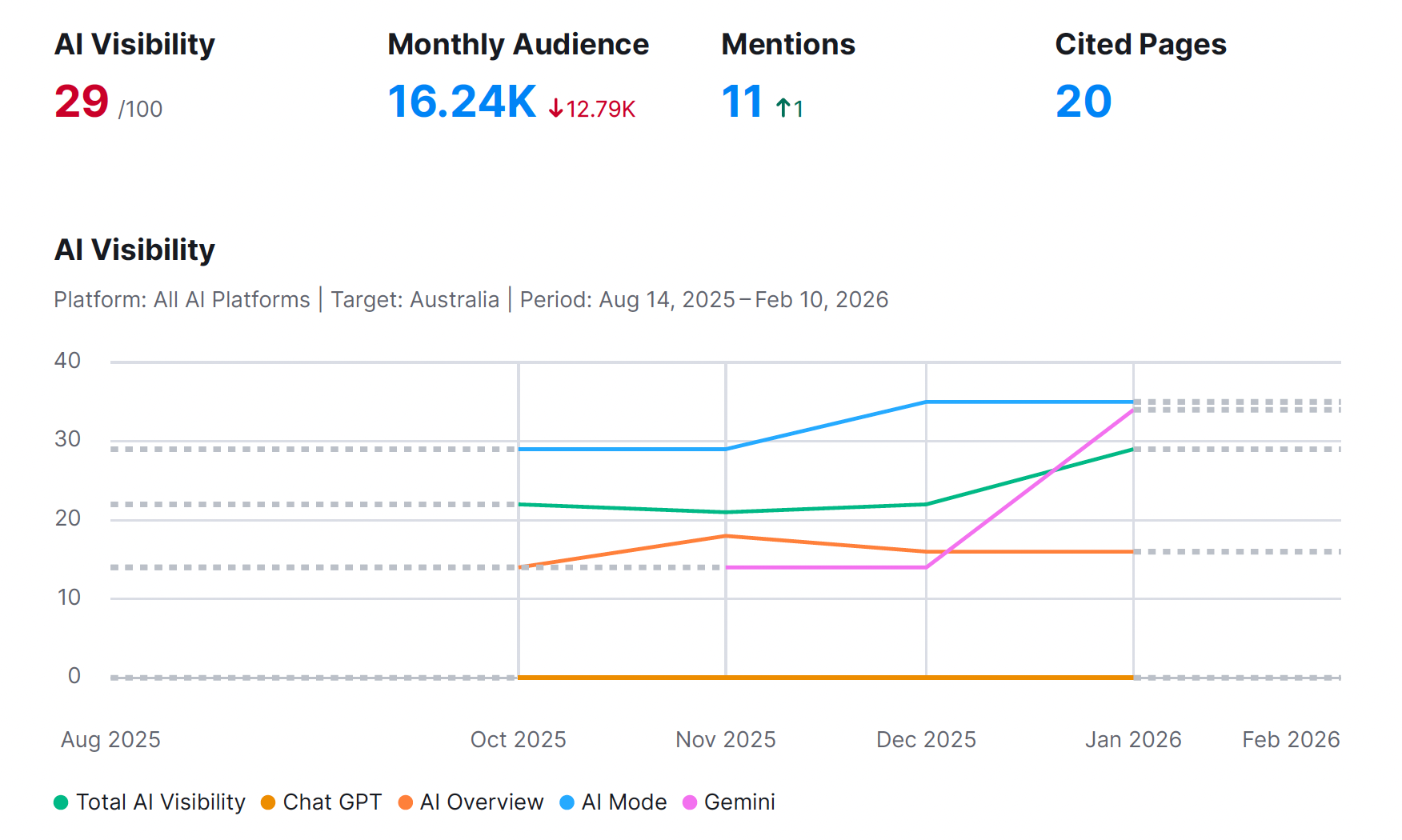
Using Semrush’s AI Visibility reporting, we can see a measurable snapshot of how often a brand appears across AI platforms, including ChatGPT, Google’s AI Overview, Gemini and other AI modes.
For BeKonstructive Marketing, this data shows:
- An AI Visibility score of 29/100
- A measurable monthly audience trend
- Mentions across multiple AI platforms
- 20 cited pages contributing to visibility
This is important for two reasons:
First, it gives us a baseline.
AI visibility isn’t about being “in” or “out” – it’s about understanding where you sit now, and whether movement over time reflects strategic changes.
Second, it reveals distribution.
If visibility is concentrated on one platform but absent on another, that tells us something about content structure, authority signals and platform behaviour. If mentions are happening only in informational prompts but not in commercial ones, that also tells us something.
In other words: this score isn’t the goal.
It’s a diagnostic tool.
And like any diagnostic tool, the real value isn’t in the number itself, but in what the number helps you interpret.
How AI Tools Build a Picture of Your Brand
AI search tools don’t rank pages the way traditional search engines do. The way they function is more like “profiling” – pulling in data from multiple sources to draw conclusions. We unpack the difference between SEO and AI Search in a recent article you can read here.
Instead of looking at one URL and assigning it a position, AI platforms analyse patterns across:
- brand mentions
- cited pages
- topical relevance
- third-party sources
- consistency across content types
When we review the AI Visibility reporting for BeKonstructive Marketing, we can see that visibility isn’t coming from one standout blog post or a single high-performing service page. It’s distributed.
For example:
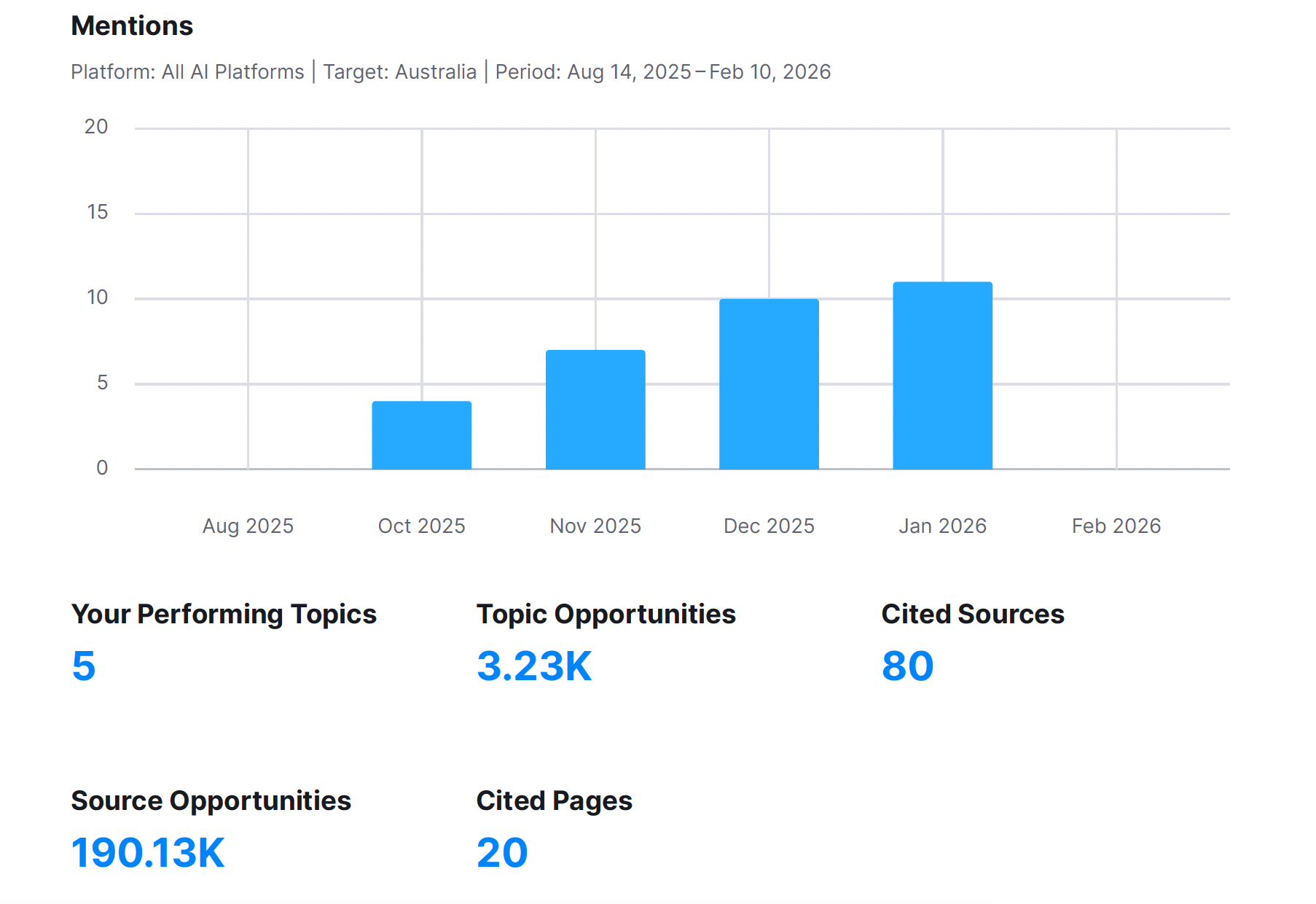
- There are 11 brand mentions recorded across AI platforms.
- There are 20 cited pages contributing to visibility.
- AI associates the brand with specific topics, not just the business name itself.
This tells us something important: AI tools are connecting dots across multiple pieces of content and not just ranking a “best” page (which is how traditional SEO functions).
In traditional SEO, you might optimise a single landing page and push it up the rankings.
In AI search, visibility depends on whether your broader digital footprint supports the recommendation.
That includes:
- how clearly your services are defined
- whether your content reinforces your positioning
- whether external sources reference you consistently
- whether outdated or conflicting content exists (learn more about that here)
AI Search isn’t looking for a perfectly optimised page, it’s looking for coherence.
Why This Changes the Way We Approach Optimisation
Because AI tools synthesise information, not just list links, our job shifts from:
“How do we rank this page higher?”
to:
“Does the overall brand narrative support being recommended?”
That’s a different question entirely.
It means optimisation may involve:
- tightening service messaging
- refining copywriting so positioning is clearer
- strengthening topical authority through supporting content
- improving internal links so context is easier to interpret
And importantly, it also means: Sometimes the issue isn’t lack of content, it’s lack of consistent messaging.
A Practical Example: Topic Association
One of the most valuable parts of the AI reporting is topic visibility.
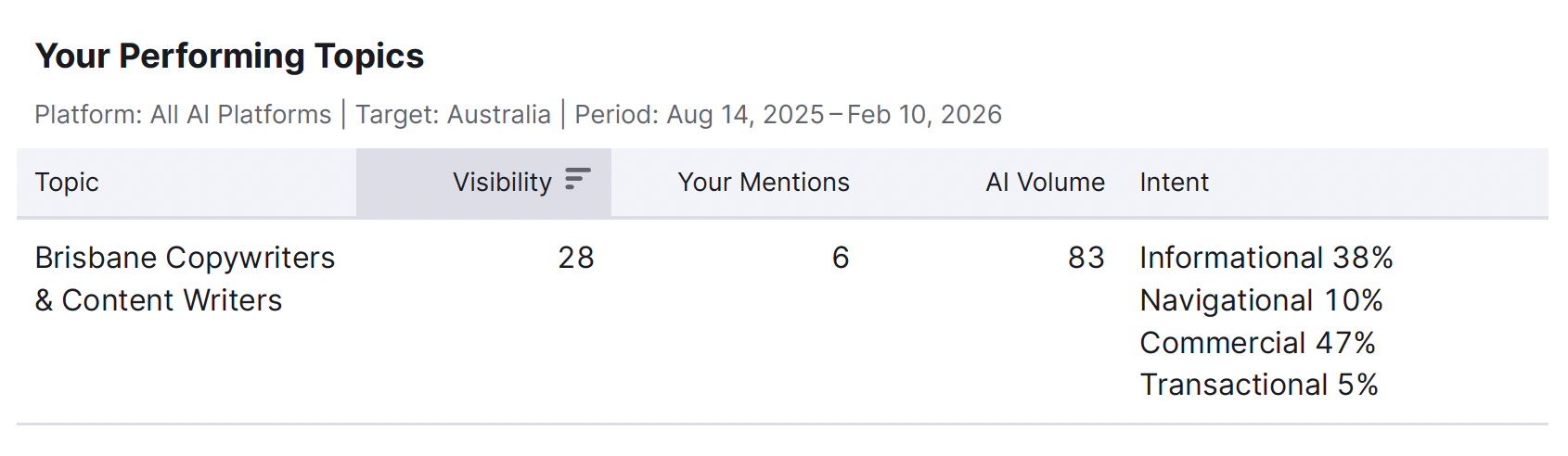
For BeKonstructive, the data shows strong association with topics such as Brisbane copywriters and content writers, with a blend of informational and commercial intent.
That tells us:
- AI understands our relevance within that space.
- It recognises topical authority beyond just our homepage.
- The content ecosystem is reinforcing itself.
If that association didn’t exist, the solution wouldn’t necessarily be “more content”.
It might be:
- clearer service definitions,
- stronger internal linking,
- or better alignment between blog topics and commercial services.
Again, the data doesn’t tell us what to publish.
It tells us where the narrative is already forming, and where it isn’t.
What AI Search Prompts Reveal About Real Visibility
If visibility scores show us how often a brand appears, prompt data shows us where and why.
And this is where AI search starts to feel very different from traditional SEO.
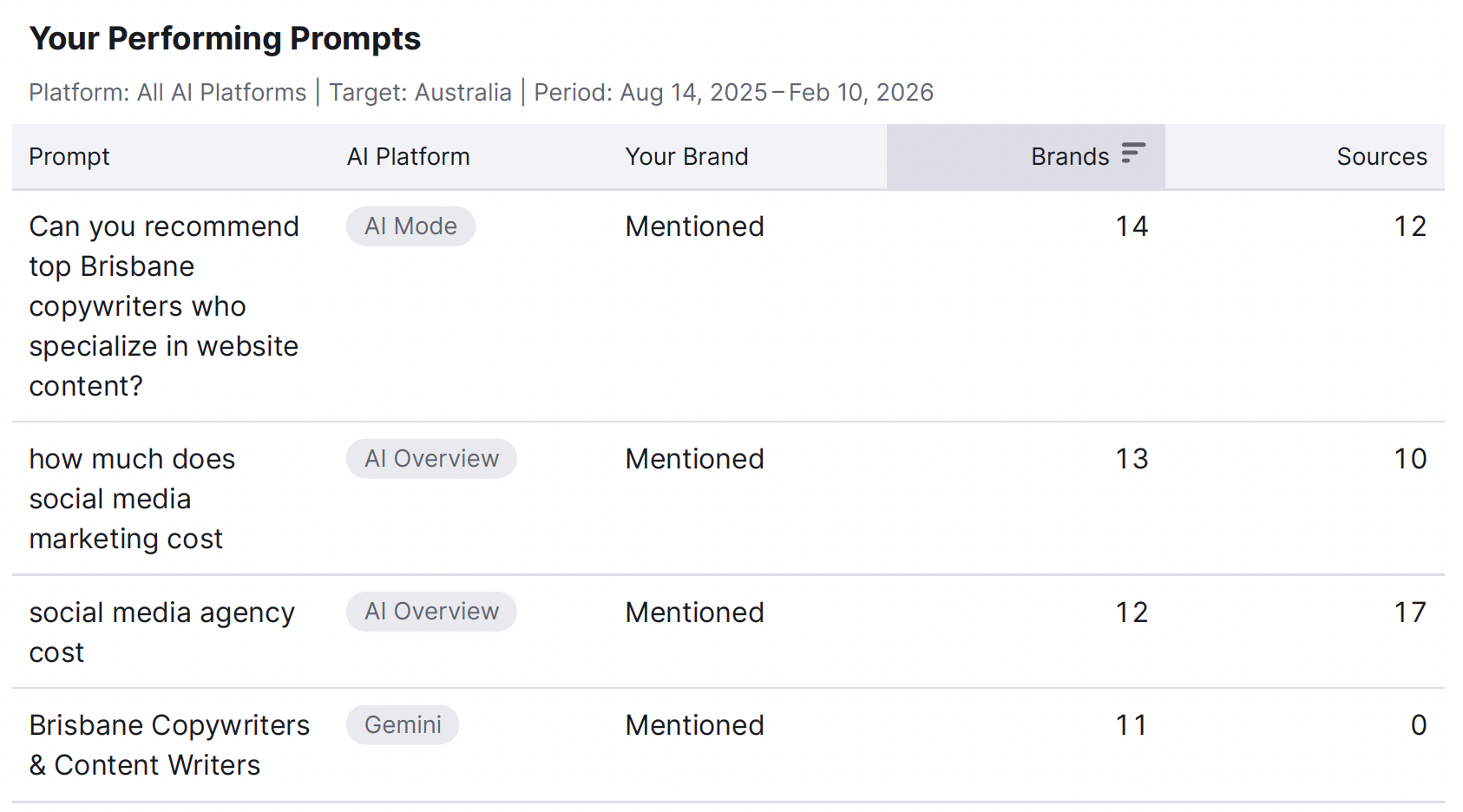
In the Semrush AI reporting, we can see specific prompts where BeKonstructive Marketing is mentioned across platforms like AI Overview, Gemini and AI Mode.
These aren’t keywords.
They’re real, conversational queries.
For example:
- “Can you recommend top Brisbane copywriters who specialise in website content?”
- “How much does social media marketing cost?”
- “Social media agency cost”
Each of these prompts represents a real user scenario, often far more detailed and intent-driven than a standard Google search. And when AI tools generate a response, they don’t simply list links.
They analyse:
- which brands are consistently associated with the topic
- what those brands say about themselves
- how third parties reference them
- and whether their content aligns with the user’s criteria
If a brand meets the conditions, it’s included in the response. If it doesn’t, it isn’t.
Why This Matters More Than Rankings
In traditional SEO, success is visible.
You can see:
- Page 1 rankings
- Click-through rates
- Organic traffic
In AI search, visibility is embedded inside the answer.
There’s no “position 1” in the same way. There’s inclusion or exclusion, and that’s a very different competitive dynamic.
Prompt-level data allows us to see:
- whether visibility is happening during informational research
- whether it’s occurring in commercial or pricing-based prompts
- and whether a brand is present during recommendation-stage queries
For example, seeing mentions inside pricing-related prompts tells us that AI associates our brand with commercial evaluation, not just education. That distinction is important because it means visibility is happening at a stage where decisions are being formed.
The Real Insight: Visibility Is Contextual
Prompt data also reveals something else:
AI doesn’t recommend brands randomly, it looks for contextual alignment.
If someone asks:
“Which Brisbane copywriters specialise in website content?”
AI tools will favour brands that:
- clearly state website copywriting as a service
- have supporting articles or case studies
- are referenced by third parties in that context
- demonstrate consistent positioning across platforms
If that context is missing, even if the service exists, then visibility weakens. This is why we don’t treat AI search optimisation as “add more content”.
We treat it as:
- reinforce the narrative,
- align the ecosystem,
- and remove ambiguity
Why We Don’t Chase Every AI Search Opportunity
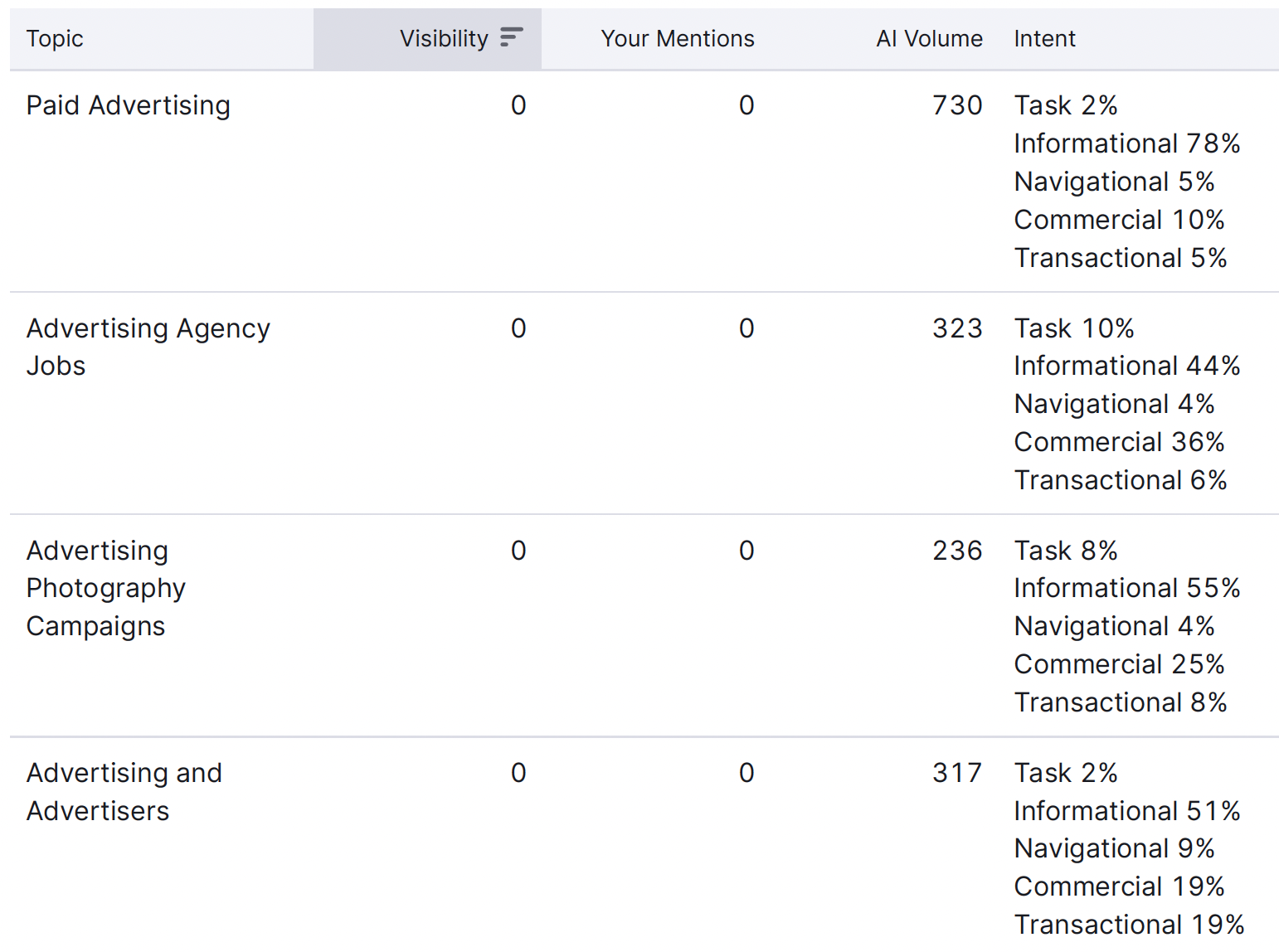
One of the most misleading parts of AI visibility reporting is the volume of “opportunities”.
When you open an AI Search report, you’ll see:
- missed prompts
- missed topics
- missed source opportunities
- domains where competitors are cited and you’re not
It can be tempting to treat that list like a to-do checklist.
We don’t.
Because not every opportunity is commercially relevant. Data shows possibility, but strategy determines priority.
For example, AI reporting might surface:
- high-volume informational prompts
- adjacent service categories
- broader industry terms
- or competitor-dominated spaces
Technically, these represent “visibility gaps”.
But the question we ask is not:
“Can we get mentioned here?”
It’s:
“Should we?”
If a topic:
- sits outside a client’s core service offering
- attracts the wrong type of enquiry
- requires disproportionate effort
- or dilutes positioning
then pursuing it may increase visibility while decreasing commercial clarity.
Not All Mentions Are Equal
AI Search data shows where a brand is currently cited and where it’s missing.
But visibility in:
- informational, research-stage prompts
- pricing and comparison prompts
- recommendation-stage prompts
are all very different things.
We prioritise opportunities that align with:
- commercial intent
- service capability
- revenue goals
- and long-term positioning
That might mean strengthening visibility in high-intent prompts before chasing broader awareness. Or it might mean reinforcing existing topical authority rather than expanding into adjacent categories. And it might mean doing nothing at all, because the data confirms the current strategy is working.
AI Search Optimisation Is Not About Volume
More mentions is not automatically better. More prompts is not automatically better. More domains citing you is not automatically better. AI search rewards coherence.
If we expand visibility in a way that creates:
- inconsistent messaging
- scattered positioning
- diluted service clarity
we weaken the very signals AI tools use to recommend brands. Sometimes the most strategic move is reinforcement, not expansion.
Why AI Search Visibility Is a Marketing Communications Challenge
When people hear “AI search optimisation”, they often assume it’s either:
- a technical SEO problem, or
- a PR and backlinks problem.
In reality, it’s neither of those in isolation. AI search tools don’t just assess page structure or link profiles, they assess narrative consistency.
They analyse:
- how clearly your services are described
- whether your positioning is reinforced across platforms
- whether your case studies support your claims
- whether third parties describe you the way you describe yourself
- whether your messaging holds together under scrutiny
That isn’t just technical optimisation, it’s marketing communications. It’s having a solid, consistent brand story that you stick to everywhere. That is so strongly established, that it’s what shows through when customers mention you on social media sites, forums, reviews and other third-party platforms.
Improving AI visibility often involves:
- refining service messaging so it’s unambiguous
- tightening copywriting so intent is clearer
- aligning blog content with commercial positioning
- strengthening internal links to reinforce topical authority
- ensuring social proof supports your narrative
In other words, it’s about clarity and coherence.
As a marketing communications agency with deep SEO capability, we’re not looking at one signal in isolation.
We’re looking at:
- the technical foundations
- the content ecosystem
- the positioning
- the language
- and the commercial intent
AI search doesn’t evaluate one asset at a time, it evaluates the brand as a whole. And that’s exactly how we approach visibility.
Want to learn how BeKonstructive Marketing can help your brand increase visibility in AI search tools? Book a free AI search and SEO discovery call here.