


AI isn’t killing search engine optimisation, but it is changing how visibility works.
Traditional SEO focused on ranking your best pages. AI search tools take a broader, more holistic view of your entire digital footprint, including reviews, forums, social media, and older content you may have forgotten about. The businesses that will succeed are the ones that understand brand visibility as a whole, not just rankings in Google.
Contents
- Why AI and SEO suddenly feel uncomfortable
- What we actually mean by “AI” in SEO
- AI isn’t killing SEO – it’s exposing outdated SEO
- The biggest misconceptions about AI and search
- AI search vs traditional Google search
- What “visibility” means in an AI-driven search world
- What still matters (and always will)
- How to future-proof your SEO for AI
- SEO is becoming a brand visibility discipline
- The key takeaway
Why AI and SEO Suddenly Feel Uncomfortable
When businesses talk to us about AI and search engine optimisation, the concern usually isn’t about technology.
It’s about loss of control.
For years, SEO gave businesses a sense of certainty. You optimised your key landing pages, worked to rank on page one, and largely controlled the narrative people saw when they searched for you.
AI search changes that dynamic.
Instead of showing a small, curated selection of results, AI tools summarise everything they can find about your brand – the good, the outdated, and the uncomfortable. Reviews, forum comments, old pages, social posts and third-party mentions are all pulled into a single response.
That’s why this shift feels confronting. It’s not just about traffic; it’s about brand perception, trust, and whether your business even shows up in the conversation.
What We Actually Mean by “AI” in SEO
One of the biggest sources of confusion is that people use “AI” as a catch-all term, when in reality there are three very different things at play:
AI used by search engines
Google, Bing and other platforms now use AI to interpret intent, context and meaning – not just keywords.
AI used by marketers
Tools like ChatGPT are used to support research, ideation, drafting and analysis.
AI used by searchers
This includes AI Overviews in Google, Microsoft Copilot, ChatGPT, Gemini and other conversational search tools people use to find and evaluate businesses.
These are not interchangeable. Most misunderstandings about AI and SEO come from lumping all three together.
AI Isn’t Killing SEO. It’s Exposing Outdated SEO.
SEO isn’t dead. But old SEO thinking is being exposed.
Traditional SEO allowed businesses to polish and promote their best pages while quietly ignoring weaker areas of their online presence. If something negative existed, you could often out-optimise it with enough positive content.
AI doesn’t work that way.
AI search tools take a holistic view. They don’t just rank your most optimised pages – they summarise your entire digital footprint. That includes:
- outdated service pages
- inconsistent messaging
- negative or unresolved reviews
- forum discussions you didn’t even know existed
In short: AI is less forgiving of neglected content and brand inconsistency.
The Biggest Misconceptions About AI and Search
There are a few myths we see repeatedly.
“I don’t need to do anything yet”
Some businesses are getting early leads from AI search without really trying – but that’s only because competition is still low. As more businesses catch on, that window will close quickly.
“If I’m doing SEO, I’m covered for AI”
There’s overlap, but the weighting of signals is different. Some traditional SEO priorities matter less in AI search, while things that were once “nice to have” – like brand consistency and context – matter far more.
“Everyone’s using ChatGPT”
In reality, usage varies by environment.
- In professional settings, people often use Microsoft Copilot or Gemini.
- In personal contexts, ChatGPT and other tools dominate.
- A new partnership between Google and Apple may see the shift from ChatGPT to Gemini as the preferred platform.
“All AI tools work the same way”
They don’t. Each platform draws from different data sources, which means visibility strategies vary depending on whether you’re B2B, B2C, or eCommerce.
AI Search vs Traditional Google Search
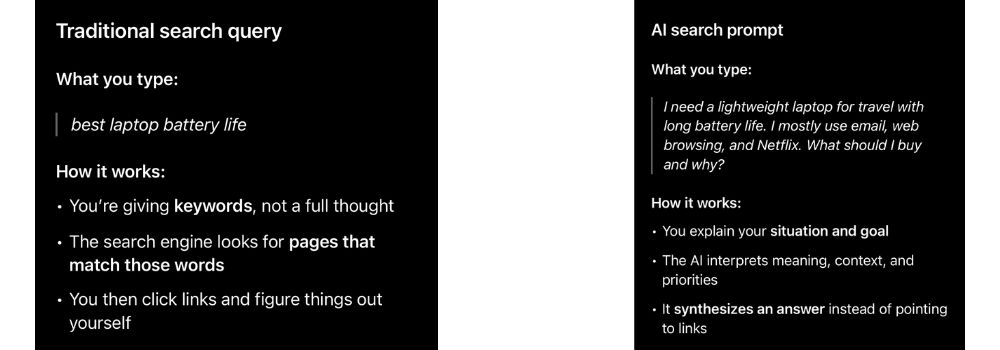
Traditional search is keyword-led.
AI search is problem-led.
Instead of typing “Brisbane SEO agency”, users now describe their situation in detail:
- what hasn’t worked
- what they’re unhappy with
- what they want to avoid
- what success looks like to them
AI tools then do the legwork – analysing websites, reviews, case studies and brand mentions – before presenting a shortlist or recommendation.
The result?
People still end up on your website, but they arrive later in the decision-making process, with far more context already formed.
This shift is why AI search deserves its own strategic focus, not just a checkbox under “SEO”.
What “Visibility” Means in an AI-Driven Search World
Visibility now shows up in three main ways:
Brand mentions
Your brand is referenced during early research and education phases.
Brand citations
Your content is used to support explanations or comparisons.
Brand recommendations
Your business is suggested as a solution when someone is ready to engage.
These stages mirror traditional search intent, but AI tools compress the journey. Being visible means being present throughout the conversation, not just ranking for one keyword.
This is where SEO, content marketing, and a strong social media presence begin to intersect naturally.
What Still Matters (More Than Ever)
Despite the noise, many fundamentals remain unchanged.
- Quality, helpful content still matters
- Clear service pages still matter
- Rankings still matter – as indicators of strength and coverage
- Trust signals still matter
SEO hasn’t disappeared. It has expanded.
Strong SEO foundations, supported by thoughtful copywriting and content marketing, make it easier for AI tools to understand who you are, what you do, and who you’re best suited to help.
How to Future-Proof Your SEO for AI
The best thing you can do to future-proof your SEO for AI is to clean up and strengthen what already exists.
Key focus areas:
- Brand consistency across your website, social profiles, and directories
- Removing or updating outdated pages
- Publishing practical, experience-based content
- Treating case studies as core assets, not vanity projects
- Driving positive reviews from happy customers
- Making sure your E-E-A-T (experience, expertise, authority, trust) signals are clear and visible
AI tools reward context and credibility. Clear examples of how you solve real problems – supported by consistent messaging across platforms – goes much further than volume alone.
This is where integrated SEO, copywriting, content marketing and social media management work best together.
SEO Is Becoming a Brand Visibility Discipline
SEO specialists are at a crossroads.
Narrow, one-dimensional SEO approaches are becoming less effective as search grows more complex. The future belongs to practitioners who understand:
- technical foundations
- content quality
- brand signals
- user behaviour across platforms
SEO is no longer just about ranking pages. It’s about how your brand shows up everywhere search happens.
The Key Takeaway
Traditional SEO focused on your top 10% – the pages you carefully curated and optimised.
AI search looks at everything.
If there’s one thing to take away, it’s this: optimising for AI means thinking about your entire brand presence, not just your best landing pages.